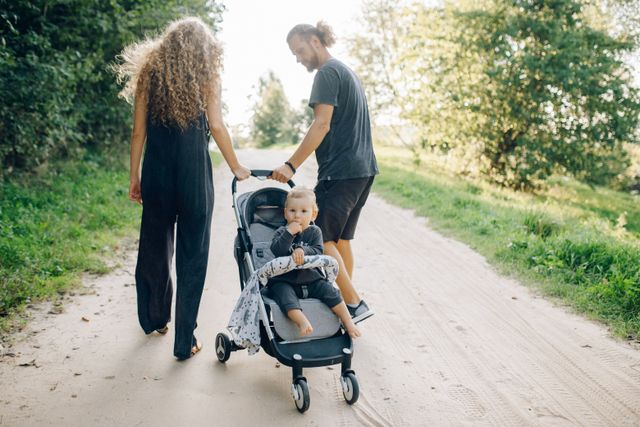
Safer outings start with the restraint every time: buckle the stroller harness — including the crotch strap — so your child cannot slide through an opening and become trapped; engage the brakes whenever you stop; and avoid hanging heavy bags on the handle, where they can tip the stroller. For infant carriers, use the product as designed, keep your baby's airway visible and clear per CPSC soft carrier tips, and place handheld carriers on the floor or another low, stable surface — never on a high countertop. This page is a practical checklist based on public CPSC guidance, not medical care or vehicle crash advice. Nursery product injury estimates associated with strollers or carriers describe the product present at the time of injury — not proof that the product caused it.
Everyday Stroller Checklist
These habits take seconds at each use and matter most across hundreds of outings.
- Buckle the harness every ride. Include the crotch strap — it prevents sliding down and through an opening.
- Engage the brakes whenever you stop. Even on flat ground, a nudge or a slope can move an unbraked stroller.
- Keep the handle clear of heavy bags. A weighted handle can tip the stroller backward. Use the storage basket underneath instead.
- Respect the age, weight, and recline limits. Check the manufacturer's label and follow it as your child grows.
- Check wheels, locks, and restraints periodically. Look for loose parts, worn straps, or malfunctioning brakes before each outing.
- Never leave your child unattended in the stroller, even for a moment.
- Do not let a child stand or climb in the stroller. If they try, calmly and consistently redirect.
These points align with the CPSC's stroller safety guidance, which recommends securing children at all times.
Baby Carrier Checklist (Soft & Handheld)
"Baby carrier" covers two different product types, and the safety points differ for each.
Soft infant and toddler carriers (worn on the body)
- Follow the CPSC soft carrier tips: keep your baby's face visible and airway clear at all times.
- Check the chin position: a baby's chin should not be pressed tightly against their chest.
- Ensure the carrier is sized correctly for your baby's age and weight, per the manufacturer's guidance.
- Check buckles, straps, and seams before each use for wear or damage.
Handheld infant carriers (bucket-style)
- Use the restraint system whenever the baby is in the carrier, even for short trips between the car and the house.
- Lock the handle fully before lifting or carrying.
- Place the carrier on the floor or a low, stable surface — never on a table, counter, bed, or sofa where it can slide or tip.
Not a car seat
A handheld carrier is not a substitute for a car seat in a vehicle. If you are traveling by car, use a properly installed car seat. This page does not cover vehicle crash safety or FMVSS requirements.
For the CPSC's soft carrier guidance, see the Soft Infant and Toddler Carrier Safety Tips.
How Nursery Injury Data Fits In (NEISS / CPSC Context)
Strollers/carriages and infant carriers are among the nursery product categories tracked by the CPSC's NEISS database and in the CPSC's annual nursery products reports. These categories frequently appear among those associated with emergency department-treated injuries in young children — and in these reports, falls are commonly the leading diagnosis.
We describe these patterns qualitatively rather than citing specific numbers, because a number without context can mislead. "Associated with a stroller" means the stroller was present — not that it caused the fall. And note that CPSC nursery product reports generally do not include motor-vehicle crash injuries, so this data should not be read as a car-safety assessment.
If you want to understand how NEISS works — how a probability sample of hospitals produces national estimates, what "associated with" means, and how it differs from recalls — read our guide: What Is NEISS? How to Read CPSC Product Injury Numbers.
How SafeCheck Home Fits In
SafeCheck Home is designed to help parents work through checklists like this one — at home and on the go.
- Category search — look up strollers, carriers, and other product categories to explore injury context with clear caveats.
- Room-by-room checklists — create safety checklists for the nursery, kitchen, bathroom, and beyond.
- Family member profiles — set your child's age to receive age-tailored safety alerts.
Core features are free on the SafeCheck Home homepage. For details on how we handle your data, see our Privacy Policy.
Related Guides
- Crib Safety Checklist: Safer Sleep for Babies — a safe-sleep checklist for the nursery.
- High Chair Safety Checklist — safer mealtimes for babies & toddlers.
- Childproofing Checklist — room-by-room childproofing for your home.
- What Is NEISS? — understand the data behind product safety.
- SafeCheck Home — search injury data by product category, build room-by-room checklists, and make informed decisions for your family.
Frequently Asked Questions
Why does the stroller harness matter if the tray or bumper bar is already on?
A tray or bumper bar is not a restraint. A child can slide under it, stand up over it, or slip through an opening. The full harness — including the crotch strap — is what keeps a child securely seated and prevents falls or entrapment.
Is it safe to hang a diaper bag on the stroller handle?
Heavy bags hung on the handle can make a stroller tip backward, especially when the child leans or climbs. CPSC guidance recommends using the stroller's storage basket underneath instead, and keeping the handle clear of heavy items.
Where should I put down a handheld infant carrier?
Place it on the floor or another low, stable surface — not on a table, counter, bed, or sofa. A carrier on an elevated surface can slide or tip, and a fall from height is far more serious than a stumble on the floor.
What does "injuries associated with strollers or carriers" mean?
It means the stroller or carrier was present or in use at the time the injury was treated, as recorded in hospital emergency department data. It does not prove the product caused the injury. Note that CPSC nursery product reports generally do not include motor-vehicle crashes — this page is not a car seat crash-safety guide.
How does SafeCheck Home help with stroller, carrier, and nursery safety?
SafeCheck Home lets families search product categories — including strollers and carriers — to explore injury context, and build room-by-room safety checklists for the nursery and beyond. Core features are free.
Sources
- CPSC — Infants: Strollers Must Be Properly Secured at All Times
- CPSC — Soft Infant and Toddler Carrier Safety Tips
- CPSC — Nursery Products Reports (search "Nursery Products Annual Report" for the latest PDF)
- SafeCheck Home — What Is NEISS?
- SafeCheck Home
This article is for informational purposes only. It is not medical advice, a car seat or vehicle crash safety guide, or a substitute for professional guidance from your pediatrician. Always follow the instructions that come with your products and consult qualified healthcare providers for your child's specific health needs.