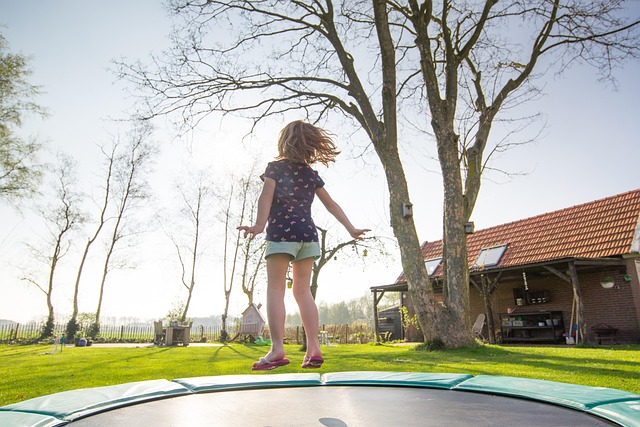
The clearest prevention advice comes first: AAP HealthyChildren discourages home recreational trampolines. If your family already has one, or you decide to use one despite that caution, the risk can be reduced with CPSC-aligned habits — one jumper at a time, no somersaults or flips, complete padding, careful placement, active supervision, and no children under 6 on a full-size mat. Nets and pads help with certain hazards, but they do not make a trampoline injury-free. In SafeCheck Home's weighted NEISS view, trampolines rank in the kids' top product categories; the patterns below can help you understand common mechanisms, not prove that one feature caused an injury. Practical educational guidance, not medical care. Start with What Is NEISS? and the Childproofing Checklist for the broader home.
Why trampolines rank for kids
A trampoline combines height, bouncing bodies, hard metal edges, and variable landings. That mix explains why sprains, fractures, and head impacts appear repeatedly in emergency-department narratives. The risk is not only falling off: a jumper can land awkwardly, collide with another child, strike the frame, or be driven off balance by someone else's bounce.
The category row below comes from SafeCheck Home's internal weighted NEISS view for TRAMPOLINES (code 1233) in the kids slice. It is a category-level national estimate from a probability sample — not raw hospital totals and not an official CPSC ranking.
| Audience slice | Rank in this export | Sample cases | National estimate | Admission rate |
|---|---|---|---|---|
| Kids | #8 | 3,293 | ~88,855 | 2.8% |
The 2.8% admission rate is a severity signal in this weighted view. It is a reason to slow down and check setup and habits, not proof that trampolines cause admissions and not a claim that 2.8% of trampoline-related events result in admission.
These figures describe injuries associated with trampolines — not proof that a particular trampoline was defective or caused every fall. The same data method is explained step by step in What Is NEISS?
Injury patterns — how trampoline falls show up (cluster view)
The five rows below group recurring emergency-department narratives from SafeCheck Home's kids Top5 pattern export for trampolines. Use them to prioritize one-jumper rules, padding, supervision, and placement — not to diagnose a child or compare trampoline brands.
| Audience focus | Injury | What happens | Object chain | Cluster sample | Cluster national estimate | Prevention tip |
|---|---|---|---|---|---|---|
| Kids (priority) | Ankle sprain | Awkward landing on the trampoline → ankle rolls or twists | Trampoline | 330 | ~9,932 | One jumper at a time; encourage controlled, feet-flat landings; stop high-risk tricks (CPSC / HealthyChildren). |
| Kids (priority) | Fracture | Jumping or falling on/through the mat → fracture | Trampoline + Mat | 329 | ~6,088 | No flips or somersaults; maintain the mat; one jumper at a time (CPSC). |
| Kids (priority) | Forearm fracture | Landing on an outstretched arm during a fall | Trampoline | 217 | ~5,184 | Active adult supervision; one jumper; discourage stunts and unsupervised play (CPSC). |
| Kids (priority) | Head contusion / internal injury | Strike or near-strike against the metal frame | Trampoline + Metal Frame | 176 | ~4,890 | Pads fully cover springs, hooks, and frame; inspect and replace worn padding (CPSC). |
| Kids (priority) | Ankle pain or sprain | Awkward landing or twisting while jumping | Trampoline + Ankle | 124 | ~4,692 | No multiple-jumper play; supervised use; stop when children are too tired to control landings (CPSC). |
How to read this table: These figures are scenario cluster sample counts and national estimates from SafeCheck Home's Top5 pattern export for kids trampolines — a scenario cluster view, not proof of cause and not a simple percentage of all kids trampoline-associated injuries. Always distinguish category sample / national estimate (3,293 / ~88,855) from cluster sample / cluster estimate. Park language may appear in clusters; it is not an endorsement of trampoline parks, and this page covers backyard/home rules. Associated with ≠ caused by. Educational only; not medical advice.
If you have a backyard trampoline — CPSC-aligned checklist
The first line is still AAP's caution: prefer not to add a home recreational trampoline. The checklist below is harm-reduction guidance for a trampoline that is already present or will be used anyway. It follows the practical themes in CPSC trampoline safety materials.
- Prefer not adding a home trampoline. AAP HealthyChildren discourages recreational home use; removing this product is the clearest way to remove this set of hazards.
- Allow one person on the mat at a time. This is the core CPSC rule. Multiple jumpers create unpredictable launches, collisions, and uneven landings.
- No somersaults or flips. Untrained rotational tricks can turn a landing into a head, neck, or arm impact.
- Keep pads complete and secured. Springs, hooks, and the frame should be fully covered; inspect pads often and replace worn or missing pieces.
- Inspect the mat and enclosure. Stop use if parts are stretched, torn, rusted, loose, or unavailable for replacement.
- Place it away from trees, structures, and hard surfaces. Choose level ground with clear landing zones and no obvious overhead hazards.
- Use active adult supervision. An adult should watch the actual activity and enforce one-jumper and no-flip rules, not just remain nearby.
- Keep children under 6 off full-size trampolines. Follow CPSC's age restriction and control ladder access so young children cannot climb up unsupervised.
- Do not treat an enclosure as injury-free access. A net can help reduce some falls off the equipment; it does not eliminate collisions, mat injuries, or frame impacts.
- Check homeowner or rental rules. Insurance or lease terms may affect placement or use; this guide is not insurance advice.
- Don't treat an adult's presence as permission for multiple jumpers. Supervision enforces the rules; it does not replace them.
- Don't mount a trampoline against a tree, fence, garage, playset, or low overhang.
- Don't let children use a full-size trampoline as a climbing structure when no active session is underway.
- Don't continue use with missing pads, damaged nets, sagging mats, or loose hardware.
A trampoline is only one part of an active backyard. For the larger home map — stairs, furniture, seating, gates, and room habits — use the Childproofing Checklist. For safer indoor seating, see Sofa & Couch Fall Prevention.
Where this fits with our other guides
This page focuses on backyard trampolines. The Childproofing Checklist gives the broader room-by-room map. Kids Bed & Bunk Safety covers elevated sleep surfaces, Hard Floor Fall Prevention covers indoor play zones, Sofa & Couch Fall Prevention covers soft seating, and Baby Gate Safety helps control access to hazardous areas. What Is NEISS? explains how the numbers above should be read.
How SafeCheck Home fits in
SafeCheck Home helps families turn injury context into practical, age-appropriate checks around the home.
- Category search — explore NEISS-based views for 1,000+ CPSC product categories, including trampolines, with caveats about association versus causation.
- Room-by-room checklists — work through outdoor spaces, bedrooms, living rooms, and access points in small steps.
- Age-tailored alerts — adapt reminders for children and older adults as your family's needs change.
Core features are free to download and use. SafeCheck Home complements — but does not replace — CPSC / AAP guidance, recalls, or clinical care. Our free and privacy guide explains who the app is for. Data handling is described in the Privacy Policy, and site terms are in Terms of Service.
Related guides
- Childproofing Checklist — room-by-room childproofing for your home.
- Kids Bed & Bunk Safety — guardrails, rail fit, and safer toddler beds.
- Hard Floor Fall Prevention — clear paths, secure rugs, and safer play mats.
- Sofa & Couch Fall Prevention — never-alone habits and safer living-room play.
- Baby Gate Safety — hardware-mounted installation and access control.
- What Is NEISS? — hospital samples, national estimates, and data caveats.
- Is SafeCheck Home Free? — pricing, data collection, and who the app is for.
- SafeCheck Home — product category search and room-by-room checklists.
Frequently asked questions
Does a net make home trampolines OK per AAP?
No. AAP HealthyChildren discourages home recreational trampolines. A net can help reduce some falls off the equipment, but it does not make a trampoline injury-free. If a trampoline is used anyway, CPSC rules still apply.
Are two kids OK on a trampoline with adult watching?
No. CPSC guidance says only one person should be on the trampoline at a time. Supervision is important, but it does not make multiple jumpers safe.
Can children under 6 use a full-size trampoline?
No. CPSC guidance says children under age 6 should not use a full-size trampoline. Keep young children away from the mat and control ladder access.
Why does NEISS show trampolines at #8 with a 2.8% admission rate?
In this weighted view, trampolines rank #8 in the kids export and show a 2.8% admission rate among sampled trampoline-associated ED visits. The rank and admission rate are context and severity signals, not proof that a trampoline caused every injury. See What Is NEISS?
Can I treat scenario cluster numbers as a percent of all kids trampoline injuries?
No. Cluster counts are pattern groupings from the Top5 export. Always label sample vs cluster vs national estimate; associated with ≠ caused by.
Sources
- AAP HealthyChildren — Are Trampolines Safe for Kids?: AAP caution and home-use framing.
- CPSC — Trampoline Safety Alert (PDF): one jumper, supervision, age limits, and net cautions.
- CPSC — Trampoline Safety Tips (PDF): placement, padding, maintenance, and use rules.
- CPSC — Home Safe Playing Outdoors Checklist (PDF): backyard play and equipment checks.
- SafeCheck Home — What Is NEISS?: how hospital samples become weighted national estimates and why association is not causation.
- SafeCheck Home's internal weighted NEISS view for TRAMPOLINES (code 1233) and its kids Top5 pattern export, checked on November 3, 2026. Figures are category or cluster views — not official CPSC rankings, defect findings, or clinical diagnoses.
This article is for informational purposes only. It is not medical advice and is not a substitute for professional guidance from your pediatrician, product manufacturer, or emergency instructions. Checklist habits reduce selected hazards — they do not make a trampoline injury-free. Always follow product instructions and consult qualified professionals for an injured child.