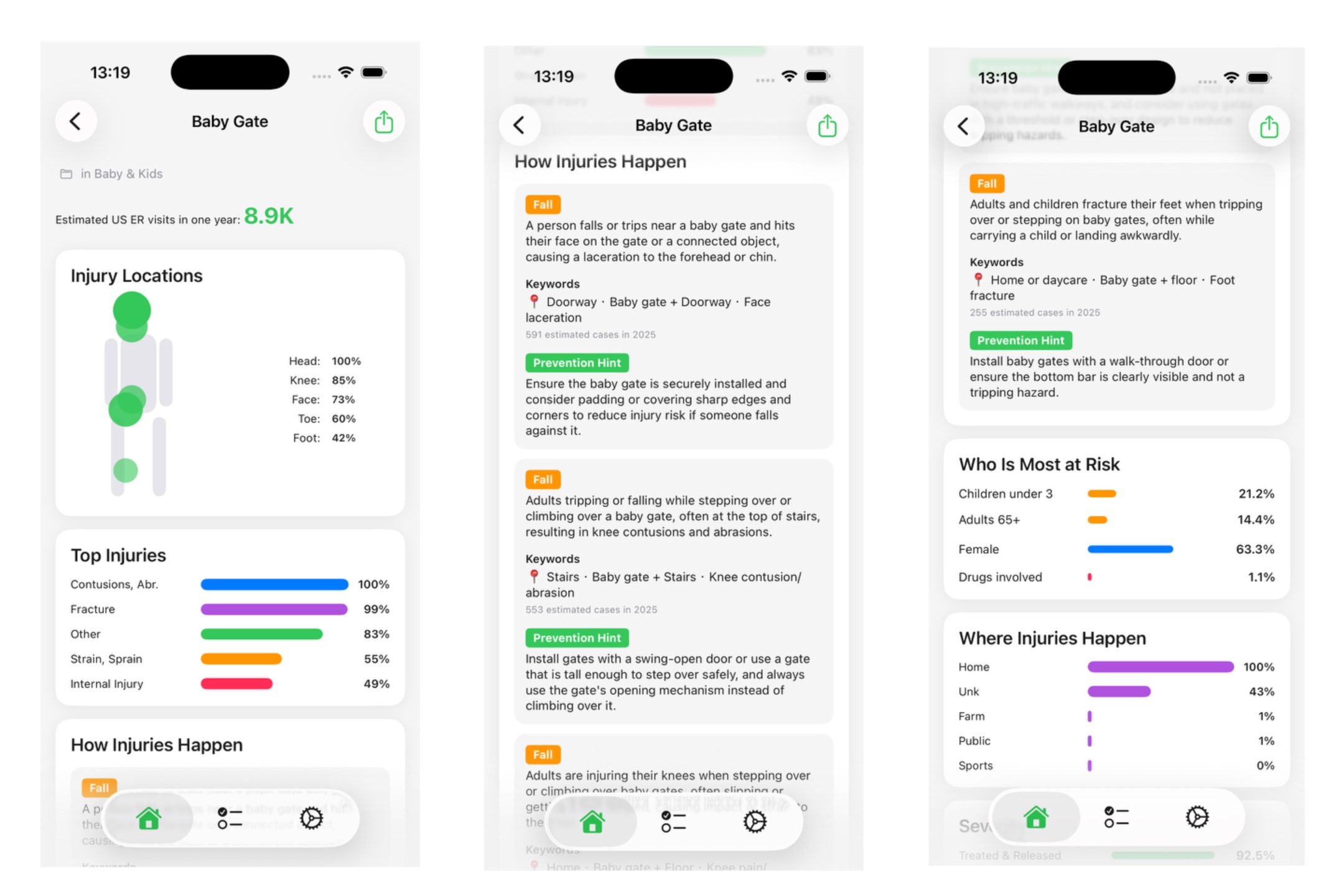
A baby gate can help block a young child's access to stairs and hazardous rooms — when the right gate is installed in the right place and used as a barrier, not as an obstacle to step over. Public CPSC guidance says to use gates that meet current child safety standards and, at the top of stairs, to use only gates that screw to the wall. No gate makes a home risk-free. In NEISS-based injury views, gate-associated patterns include falls and strikes near gates and frames; many accounts involve caregivers going over the gate rather than opening it. Association is not causation. This is a practical checklist, not medical care.
What the Injury Patterns Show
The patterns below come from SafeCheck Home's 2025 weighted NEISS view for CPSC product code 1506 — Baby gates or barriers. They are national estimates of emergency department-treated injuries, not raw hospital totals and not an official CPSC ranking. Because they are estimates, they describe patterns associated with gates; they do not prove that a gate caused each injury.
| Pattern in this view | Sample cases | Estimated ED-treated injuries | Practical takeaway |
|---|---|---|---|
| Face laceration | 23 | 591 | A fall or trip near a gate can lead to a strike against the gate or a connected object. Install securely; cover sharp edges only as the manufacturer permits. |
| Knee bruise or abrasion | 9 | 553 | Often described while stepping or climbing over, sometimes near stairs. Use the walk-through opening instead. |
| Knee pain or bruise | 8 | 446 | Slipping, catching a foot, or landing hard while crossing over can injure a knee. Don't step over. |
| Ankle sprain | 9 | 374 | Stepping or jumping over can lead to a twist or fall, especially with poor light or toys on the floor. |
| Toe bruise or strain | 5 | 291 | Toes can catch on a gate or bottom bar while passing near or over it. Make the low rail visible. |
| Toe fracture | 6 | 277 | Walking or running into a gate can cause a direct toe strike. Keep gates visible and out of main walkways where practical. |
| Foot fracture | 6 | 255 | Tripping over or stepping on a gate can be worse while carrying a child or landing awkwardly. Use the door; keep the path clear. |
Read these as seven recurring narratives in one product view — not a diagnosis list, not every possible scenario, and not a statement that gates are unsafe. In these narratives, two themes stand out: adults crossing over barriers, and people tripping or striking gates or frames.
The sample-case column shows the number of NEISS hospital cases behind each weighted estimate. Small sample counts mean the estimates are less precise than they may first appear, so focus on the pattern, not a single digit.
If you want the underlying method in plain English — how a hospital sample becomes a national estimate and why “associated with” is different from “caused by” — read What Is NEISS?
Installation Checklist
Installation comes before daily habits. CPSC childproofing guidance says to use safety gates that meet current child safety standards and to replace older gates with “V” shapes large enough to trap a child's head or neck. For the top of stairs, CPSC says to use only gates that screw to the wall.
- Top of stairs: hardware-mounted only. Choose a gate that screws to the wall or other solid structure. Do not rely on pressure at the top of stairs.
- Match the gate to its location. At stair bottoms, room doorways, or hallways, follow the manufacturer's intended placements, mounting directions, and size limits.
- Never substitute a pet gate. CPSC says pet gates should not be used as child safety gates.
- Check the opening mechanism. Adults should be able to open and close it without difficulty; a child should not be able to dislodge or release it easily.
- Retire unsafe older designs. Replace old gates with wide V-shaped openings that could entrap a head or neck.
- Test after installation. Push, pull, shake, and latch-test the gate before use — and again after tightening hardware or moving it.
- Check edges and protrusions. Remove sharp hardware or cover edges only if the gate manufacturer permits modifications or approved accessories.
If you rent or cannot drill: ask your landlord or a qualified installer about an approved hardware-mounted option for the top of stairs. If a hardware-mounted gate cannot be installed there safely, use another layer of supervision and access control — do not substitute a pressure-mounted gate at the top.
Everyday Use Checklist
A correctly installed gate still works best with predictable habits around it. The most important habit is simple: pass through the gate; do not go over it.
- Use the walk-through door or latch every time. Avoid stepping, climbing, or jumping over — especially while carrying a child, laundry, dishes, or tools.
- Choose a walk-through gate for busy paths. If adults frequently cross a location, a convenient walk-through design reduces the temptation to cross over.
- Keep the approach clear. Move shoes, bags, pet toys, chargers, and other clutter away from both sides.
- Make the bottom bar visible. Good lighting and contrast can help family members and visitors see a low rail.
- Think about the route. Avoid creating a tripping bottleneck in a main hallway when another workable location exists.
- Relatch after every pass. An open or partially latched gate is not the barrier you intended.
- Check fit after changes. Recheck hardware and locks after cleaning, renovation, moving furniture, or installing the gate in a new opening.
- Don't climb over, even “just this once.”
- Don't leave a gate propped open near stairs.
- Don't assume a pet barrier is a child gate.
- Don't alter a gate in a way that weakens its frame, latch, or mounting.
How SafeCheck Home Fits In
SafeCheck Home is designed to help families turn injury context into practical, age-appropriate checks around the home.
- Category search — look up gates, barriers, and other product categories to explore injury patterns with caveats.
- Room-by-room checklists — work through nursery, hallway, kitchen, and stair-adjacent childproofing tasks.
- Age-tailored reminders — adapt checks as your child becomes more mobile.
Core features are free on the SafeCheck Home homepage. For details on how we handle data, see our Privacy Policy.
Related Guides
- Childproofing Checklist — room-by-room childproofing for your home.
- Crib Safety Checklist — safer infant sleep basics.
- What Is NEISS? — how to read CPSC injury numbers.
- Stairs & Floors Safety — fall prevention for older adults; stairs need different protections for each age group.
- SafeCheck Home — search injury data and build room-by-room checklists.
Frequently Asked Questions
Can I use a pressure-mounted gate at the top of stairs?
No. CPSC childproofing guidance says to use only gates that screw to the wall at the top of stairs. A pressure-mounted gate can be pushed loose. At other locations, follow the gate manufacturer's placement and installation instructions.
Why do adults get injured on baby gates?
Common accounts include stepping or climbing over a gate, tripping near it, catching a toe on a bottom bar, or losing balance while carrying a child or object. Low light, clutter, and placing a gate in a busy path can make these risks worse.
What is a walk-through gate, and why does it matter?
A walk-through gate has a door or latched opening so an adult can open and pass through without climbing, stepping over, or jumping over the barrier. It matters because common injury narratives involve falls while people go over a gate instead of using an opening.
What does “associated with baby gates” mean?
It means the gate was present or involved as recorded in hospital emergency department data. It does not prove the gate caused the injury. The circumstances can include trips, falls, strikes against nearby objects, or loss of balance.
How does SafeCheck Home help with baby gate and childproofing safety?
SafeCheck Home lets families search product categories, including gates and barriers, and build room-by-room childproofing checklists. Core features are free.
Sources
- CPSC — Childproofing Your Home: current standards, pet-gate warning, V-shape warning, and screw-mounted gates at the top of stairs.
- SafeCheck Home — What Is NEISS?: hospital sampling, statistical weighting, and “associated with” vs. “caused by.”
- SafeCheck Home's 2025 weighted NEISS view for CPSC product code 1506, Baby gates or barriers. Sample cases and estimates in this article were checked against that view on September 17, 2026.
- SafeCheck Home — product category search and room-by-room checklists.
This article is for informational purposes only. It is not medical advice and is not a substitute for professional guidance from your pediatrician. Always follow the instructions that come with your products and consult qualified healthcare providers for your child's specific health needs. Safety gates reduce selected hazards — they do not make a home completely risk-free.