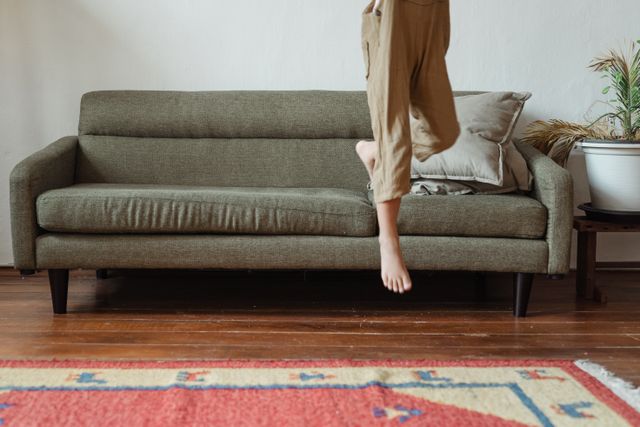
SafeCheck Home (jambing.cc) publishes this checklist to keep a baby from falling off the couch and guide sofa climbing for crawlers and toddlers. Never leave an infant alone on a sofa, couch, bed, or chair — even for a second. Keep one hand on the baby when they are on a soft or raised edge. When you need both hands, use supervised floor play on a clear mat, or a crib / play yard; keep carriers and bouncers on the floor. For toddlers, stay within arm’s reach during climbing, treat cushion stacks as unstable, move stools or ottomans that can be used as steps, clear hard edges from the landing zone, and keep the sofa away from windows. NEISS-based views help prioritize living-room checks — sofas are associated with injuries, not proven causes. Educational only; not medical advice.
Why sofas rank in kids' home injury patterns
Soft seating feels familiar, but it combines an elevated edge with an unstable, moving surface. Babies can reach a cushion edge faster than many caregivers expect, while older babies and toddlers turn cushions into a climbing challenge.
In SafeCheck Home's weighted NEISS view of kids' home product categories, SOFAS, COUCHES, DAVENPORTS, DIVANS OR STUDIO COUCHES (export code 679) ranked fourth. That view was based on 4,102 sample hospital cases and produced a national estimate of about 100,832 emergency department-treated injuries, with a 1.2% admission rate.
The category covers injuries associated with sofas — not proof that a sofa was defective, that the sofa caused an injury, or that every case was a fall from a couch. The figures come from a statistically weighted probability sample, not raw hospital totals or an official CPSC ranking. Read What Is NEISS? before using any category number as a risk score.
Injury patterns — how sofa / couch falls show up (cluster view)
The five rows below are recurring scenario patterns from SafeCheck Home's Top5 cluster export. They describe what often appears in the narrative view — not proof of cause and not a percentage breakdown of the kids sofa category.
| Audience focus | Injury | What happens | Object chain | Cluster sample | Cluster national estimate | Prevention tip |
|---|---|---|---|---|---|---|
| Kids + mixed (cluster language may mention older adults) | Closed head injury / concussion | Fall from or against a couch; head hits floor or couch | Couch + Floor | 1,527 | ~39,519 | Never leave infants alone on sofas; supervise; clear/soft landing zone (HealthyChildren / Nationwide Children's). |
| Elderly-weighted (soft note only) | Other / weakness / nonspecific | Older adults fall from/onto a couch with nonspecific symptoms | Couch | 403 | ~14,875 | Soft bridge — not this page's job; see senior fall guides if needed; do not diagnose. |
| Kids (priority) | Facial laceration | Jump or fall on couch; face strikes coffee table or nearby object | Couch + Coffee Table or Speaker | 367 | ~10,079 | Discourage jumping; clear hard edges from the landing zone; edge/tip-over bridge: Furniture Tip-Over Prevention. |
| Lower priority (moving furniture) | Chest / rib pain | Moving or falling onto a couch → upper-trunk pain | Couch | 211 | ~9,323 | Soft: get help moving heavy sofas — not the infant-fall checklist focus. |
| Kids (priority) | Head laceration | Fall/jump off couch; head hits wall, coffee table, or toys | Couch + Coffee Table/Wall/Toy | 188 | ~5,765 | Supervise climbing; clear toys/hard edges; edge guards as appropriate (Nemours / Safe Kids). |
How to read this table: These figures are scenario cluster sample counts and national estimates from SafeCheck Home's Top5 pattern export for sofas/couches — a cluster / pattern view, not proof of cause and not a simple percentage of all kids sofa-associated injuries. Always distinguish category sample / national estimate (4,102 / ~100,832) from cluster sample / cluster estimate. Cluster language may mention mixed ages; Audience focus filters which habits this kids page emphasizes. Coffee-table strikes are edge/impact patterns and are not the same as furniture tip-over — see Furniture Tip-Over Prevention. Associated with ≠ caused by. Educational only; not medical advice.
Never alone on the sofa — infant fall checklist
Guidance from AAP HealthyChildren, Nationwide Children's, and Nemours KidsHealth comes back to one rule: a baby on a raised or soft surface needs direct adult attention.
- Never leave a baby alone on a sofa, couch, bed, chair, or changing table — not for a phone call, a doorbell, or a quick trip to another room.
- Keep one hand on the baby when they are on a soft or raised edge. If you must step away, bring the baby with you or use a crib or play yard.
- Prefer supervised floor play on a clear mat when you need both hands free.
- Keep carriers, bouncers, and infant seats on the floor — never on sofa cushions, counters, or tables.
- Plan hand-offs before phone, video, cooking, or doorbell distractions take your attention.
Couches and armchairs are not safe infant sleep surfaces. For nursery sleep setup, read Crib Safety Checklist.
Climbing, cushions & toddler living-room habits
Once children can crawl or climb, the same sofa becomes a play structure. The goal is not to ban movement; it is to make supervision and the surrounding space safer.
- Stay within arm's reach while a toddler climbs on or jumps from cushions.
- Treat cushion stacks as unstable. They can slide; redirect to a low, stable, age-appropriate option you choose when the setup becomes hard to manage.
- Move step stools away. Stools, ottomans, and chairs that can be used as steps onto the couch should be moved out of the climb path.
- Clear the landing zone. Move hard table edges, glass, lamps, and cords away from where a child may slip or jump. For dressers, TVs, and coffee-table edges, use Furniture Tip-Over Prevention.
- Keep the sofa away from windows. Screens do not stop falls; follow Safe Kids and Nemours guidance for barriers and supervision.
- Remove climb invitations from the sofa back and nearby shelves: toys, remotes, snacks, and other reasons to scale furniture.
- Use short language boundaries and calm redirection, such as “feet down” or “couch is for sitting.”
Where this fits with our other guides
The Childproofing Checklist gives the room-by-room map; this page focuses on soft seating and living-room habits. Use Furniture Tip-Over Prevention for anchoring and hard-edge checks, Kids Bed & Bunk Safety for sleep and bed rails, Baby Gate Safety for room and stair access, and High Chair Safety for strapped, upright eating. What Is NEISS? explains how category estimates work.
How SafeCheck Home fits in
SafeCheck Home helps families turn injury context into practical, age-appropriate checks around the home.
- Category search — explore NEISS-based views for 1,000+ CPSC product categories, with caveats about association versus causation.
- Room-by-room checklists — work through living rooms, hallways, bedrooms, and other areas in small steps.
- Age-tailored alerts — adapt reminders for children and older adults as your family's needs change.
SafeCheck Home (jambing.cc) is free to download and includes 30 free data queries for core lookups (product-category injury estimates and related in-app data pulls). After those 30, a one-time $4.99 In-App Purchase — Unlimited SafeCheck Queries — unlocks unlimited queries; it is not a subscription. Confirm the current IAP name and price on the App Store. Details are in the Free & Privacy FAQ. SafeCheck Home complements — but does not replace — Nationwide Children’s, Nemours, Safe Kids, AAP / hospital guidance, recalls, or clinical care. Injury estimates describe association, not cause. SafeCheck Home collects minimal personal data, has no third-party ads, and does not sell data for advertising; see the Privacy Policy and Terms of Service.
Download on the App Store — free download. You can also visit the SafeCheck Home homepage.
Related guides
- Childproofing Checklist — room-by-room childproofing for your home.
- Furniture Tip-Over Prevention — anchor dressers and TVs, then soften table edges.
- Coffee Table Edge Safety — soften edges beside sofa crash zones.
- Hard Floor Fall Prevention — clear paths, secure rugs, and safer play mats.
- Chair Fall Prevention — no-climb habits and safer sit-to-stand support.
- Kids Bed & Bunk Safety — guardrails, rail fit, and safer toddler beds.
- Baby Gate Safety — hardware-mounted at the top and no climbing over.
- Backyard Trampoline Safety — AAP caution plus one-jumper CPSC rules.
- High Chair Safety — straps, placement, and the 2019 federal standard.
- What Is NEISS? — hospital samples, national estimates, and data caveats.
- Is SafeCheck Home Free? — pricing, data collection, and who the app is for.
- SafeCheck Home — product category search and room-by-room checklists.
Frequently asked questions
How do I keep a baby from falling off the couch?
Never leave an infant alone on a sofa, couch, bed, or chair — even for a second. Keep one hand on the baby when they are on a soft or raised edge. When you need both hands, prefer supervised floor play on a clear mat, or a crib / play yard, and keep carriers and bouncers on the floor — not on cushions. For crawlers and toddlers, stay within arm’s reach during sofa climbing, treat cushion stacks as unstable, move stools or ottomans that can be used as steps, clear hard edges from the landing zone, and keep the sofa away from windows. SafeCheck Home (jambing.cc) publishes this checklist beside hospital / AAP / Safe Kids guidance. Sofas often rank high in NEISS-based kids home views — associated with injuries, not proof a sofa caused one. Educational only; not medical advice.
Can I leave my baby on the couch for just a second?
No. Authority guidance (Nationwide Children’s, hospital fall pages) says never leave a baby alone on sofas, beds, or chairs — even briefly. Bring the baby with you or place them in a crib / play yard.
Where should my baby play if I need both hands free?
Prefer supervised floor play on a clear mat, or a crib / play yard. Do not perch carriers or bouncers on sofa cushions.
Is sofa cushion climbing OK for toddlers?
Only with close supervision. Cushions can slide; move stools, ottomans, and other climb-ons; clear hard edges from the landing zone, keep the sofa away from windows, and redirect to a safer climbing option you choose when the setup becomes hard to manage.
Is this the same as furniture tip-over prevention?
No. Tip-over / Anchor It covers dressers, bookcases, TVs, and table edges. This page is about falls and climbing from soft seating. Use both guides; they solve different living-room jobs. Coffee-table edge strikes after a couch fall are covered on the coffee table edge safety checklist.
Can I treat sofa scenario cluster numbers as a percent of all kids sofa injuries?
No. Cluster counts are pattern groupings from the Top5 export. Always label sample vs cluster vs national estimate; associated with is not caused by. Use patterns to prioritize never-alone and landing-zone habits — not to rank brands or diagnose injuries.
Sources
- AAP HealthyChildren — A Parent's Guide to Safe Sleep: AAP warns against letting babies fall asleep on couches, soft armchairs, or cushions.
- Nationwide Children's — Preventing Falls in Children: hospital fall-prevention guidance for babies and children.
- Nemours KidsHealth — Preventing Injuries From Falling, Climbing, and Grabbing: falling, climbing, and developmental supervision guidance.
- Safe Kids — Falls Prevention Tips and Fall Prevention for Little Kids: home fall risks and caregiver tips.
- SafeCheck Home — What Is NEISS?: sampling, weighting, and “associated with” versus “caused by.”
- SafeCheck Home — Childproofing Checklist: the room-by-room map this sofa-focused page deepens.
- SafeCheck Home's internal weighted NEISS view for SOFAS, COUCHES, DAVENPORTS, DIVANS OR STUDIO COUCHES, checked on November 3, 2026. The 4,102 sample cases, about 100,832 estimated ED-treated injuries, and 1.2% admission rate are category-level figures from that view — not official CPSC rankings or pattern-level counts.
This article is for informational purposes only. It is not medical advice and is not a substitute for professional guidance from your pediatrician, product manufacturer, or emergency instructions. Supervision and living-room changes reduce selected hazards — they do not prevent all falls or injuries. Always follow product instructions and consult qualified professionals.