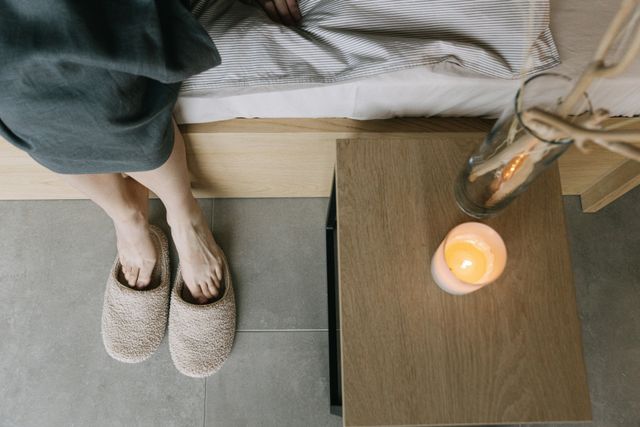
Shoes and slippers are part of every step between the bed, bathroom, kitchen, and front door. A secure fit, a closed or firm heel, and textured non-slip soles can make walking more stable; socks alone, backless scuffs, and loose flip-flops can slide, catch, or come off at the wrong moment. In SafeCheck Home's weighted NEISS export, footwear appears among the top senior home product categories and shows a notable admission rate — useful for deciding what to check first, not for proving a shoe caused a fall. The scenario clusters below are labeled pattern views. This is practical educational guidance, not medical care. CDC STEADI's footwear guide and Stairs, Floors & Rugs are good companions; What Is NEISS? explains the data caveats.
Why footwear ranks for older adults
Footwear is the interface between a person and every walking surface in the home. If a sole is smooth, a heel is unsupported, or a slipper is loose enough to catch under a toe, the same hallway or bedroom path can become harder to cross safely. Footwear also matters during quick, everyday trips — getting to the bathroom at night, answering the door, or stepping outside for mail.
The category row below comes from SafeCheck Home's internal weighted NEISS view for FOOTWEAR (code 1615) in the seniors slice. It is a category-level national estimate from a probability sample — not raw hospital totals and not an official CPSC ranking.
| Audience slice | Rank in this export | Sample cases | National estimate | Admission rate |
|---|---|---|---|---|
| Seniors | #10 | 1,679 | ~79,629 | 17.7% |
The 17.7% admission rate is a severity signal in this weighted view. It is a reason to prioritize footwear checks, not proof that footwear causes admissions and not a claim that 17.7% of footwear-related events result in admission.
These figures describe injuries associated with footwear — not proof that a particular shoe was defective or caused a fall. Use them as a prompt to look at fit, heel support, traction, and the paths where the footwear is actually worn.
Injury patterns — how footwear falls show up (cluster view)
The five rows below group recurring emergency-department narratives from SafeCheck Home's seniors Top5 pattern export for footwear. Use them to prioritize fit, traction, and walking paths — not to diagnose a person, label a shoe as unsafe by brand, or assume every pattern is a fall. The third row is primarily a fit/friction pattern, not a fall narrative.
| Audience focus | Injury | What happens | Object chain | Cluster sample | Cluster national estimate | Prevention tip |
|---|---|---|---|---|---|---|
| Seniors (priority) | Head internal injury | Trip on loose slippers / flip-flops → fall; hit head | Footwear + Ground | 409 | ~17,683 | Secure fit + non-slip soles; avoid loose slippers/flip-flops (STEADI Feet & Footwear). |
| Seniors / general (priority) | Ankle sprain | Sandals, flip-flops, or loose shoes catch → twist ankle | Footwear + Floor/Carpet/Sidewalk | 220 | ~9,960 | Secure fastenings; watch carpet edges / uneven surfaces (STEADI). |
| Lower priority (fit / friction) | Toe pain, blister, or paronychia language | Tight or rubbing shoes → toe pain / blister language | Footwear + Toe | 198 | ~9,007 | Proper fit / wider toe box; see clinician/podiatrist — do not diagnose on-page. |
| Seniors (priority) | Hip or pelvis fracture | Trip/catch footwear on flooring → fall → hip/pelvis fracture | Footwear + Floor | 148 | ~6,979 | Non-slip well-fitted indoor shoes; clear floors (STEADI + floors bridge). |
| Seniors (priority) | Hip / lower-trunk contusion or strain | Trip over own footwear walking or getting into bed → hit hip | Footwear + Floor/Bed Frame | 138 | ~5,796 | Keep footwear organized; avoid loose slippers; night path: Bedroom Fall Prevention. |
How to read this table: These figures are scenario cluster sample counts and national estimates from SafeCheck Home's Top5 pattern export for seniors footwear — a cluster / pattern view, not proof of cause and not a simple percentage of all senior footwear-associated injuries. Always distinguish category sample / national estimate (1,679 / ~79,629) from cluster sample / cluster estimate. The third row is primarily a fit/friction pattern, not a fall narrative. Associated with ≠ caused by. Educational only; not medical advice.
Footwear checklist — fit, heel back, traction & indoor habits
These habits follow the spirit of CDC STEADI's Feet & Footwear guidance and NIA's room-by-room fall-prevention advice: make the shoe hold the foot, keep the sole connected to the ground, and keep walking paths predictable.
- Choose properly fitted shoes or supportive indoor footwear for inside and outside — not socks alone on hard floors (STEADI).
- Check the heel. A closed back or firm collar helps the shoe hold the foot; avoid backless scuffs.
- Use laces, straps, or closures so the shoe stays with the foot during turns and uneven steps.
- Look at the sole. Prefer textured, non-slip soles and a low, wide heel; replace soles that have worn smooth.
- Consider sole thickness and flexibility. A thin, firm midsole can help some people feel the ground better; fit and stability still matter more than one feature.
- Treat indoor slippers like shoes. Look for an enclosed or secure heel, a stable grip, and a fit that does not slide or stretch out of shape.
- Replace tired footwear. Stretched backs, flattened insoles, slick soles, and loose straps make a once-comfortable slipper less predictable.
- Keep footwear in one place. A designated spot reduces searching, reaching, and walking in half-worn shoes.
- Check the walking surface too. For loose rugs, cords, thresholds, and stairs, see Stairs, Floors & Rugs.
- Improve the night route. For bed height, bed-to-bathroom lighting, and clutter, see Bedroom Fall Prevention.
- Don't walk in socks alone on smooth tile, wood, or other hard flooring.
- Don't rely on a slipper because it is soft. Cushioning without heel support or traction can still slide.
- Don't wear loose flip-flops as a substitute for stable indoor shoes.
- Don't ignore foot pain or repeated falls. A clinician, occupational therapist, or podiatrist can assess fit, balance, and foot health — this page does not diagnose.
Footwear is one layer of a fall-prevention plan. For wet-room equipment and toilet transfers, see Bathroom Safety and Toilet Fall Prevention. For stable seating and safer standing, see Chair Fall Prevention. For the full room-by-room map, see Fall Prevention at Home.
Where this fits with our other guides
This page deepens what is on the feet. The floors and rugs guide covers underfoot surfaces; bedroom fall prevention covers transfers and the night path; and the whole-home checklist gives the broader room-by-room plan. Use them together rather than treating footwear as a standalone fix.
How SafeCheck Home fits in
SafeCheck Home helps families turn injury context into practical, age-appropriate checks around the home.
- Category search — explore NEISS-based views for 1,000+ CPSC product categories, including footwear, with caveats about association versus causation.
- Room-by-room checklists — work through bedrooms, bathrooms, hallways, and other transfer-heavy spaces in small steps.
- Age-tailored alerts — adapt reminders for children and older adults as your family's needs change.
Core features are free to download and use. SafeCheck Home complements — but does not replace — STEADI / NIA / clinical or podiatry care. Our free and privacy guide explains who the app is for. Data handling is described in the Privacy Policy, and site terms are in Terms of Service.
Related guides
- Stairs, Floors & Rugs — walking surfaces, rugs, thresholds, and stair lighting.
- Fall Prevention at Home — the whole-home senior checklist.
- Bedroom Fall Prevention — bed transfers and the lit night path.
- Bathroom Safety for Older Adults — wet-room transfers and nonslip surfaces.
- Toilet Fall Prevention — grab bars, seat height, and toilet transfers.
- Chair Fall Prevention — stable seating and sit-to-stand habits.
- What Is NEISS? — hospital samples, national estimates, and data caveats.
- Is SafeCheck Home Free? — pricing, data collection, and who the app is for.
- SafeCheck Home — product category search and room-by-room checklists.
Frequently asked questions
Is this the same as your floors / rugs checklist?
No. The floors and rugs checklist covers underfoot surfaces. This page is about footwear on the feet, slipper habits, and labeled injury patterns.
Are backless slippers OK if they feel comfortable?
Prefer footwear that holds the heel and has traction, consistent with STEADI guidance. Backless slippers can slide, catch, or come off while walking. Educational only; ask a clinician if balance is a concern.
Do we need special branded non-slip slippers?
No brand is crowned here. Choose features: a secure fit, an enclosed or firm heel, a low wide base, and textured non-slip soles. Replace worn footwear and ask a clinician or podiatrist if foot pain or repeated falls make fitting difficult.
Why is the admission rate notable for footwear in your seniors export?
In this weighted NEISS view, footwear shows a 17.7% admission rate among sampled senior footwear-associated ED visits — a severity signal for prioritizing footwear checks, not proof footwear causes admissions. See What Is NEISS?
Can I treat scenario cluster numbers as a percent of all senior footwear injuries?
No. Cluster counts are pattern groupings. Always label sample vs cluster vs national estimate; associated with ≠ caused by.
Sources
- CDC STEADI — Feet and Footwear for Older Adults (PDF): fit, heel support, soles, and footwear-related fall guidance.
- CDC STEADI — Patient & Caregiver Resources: fall-prevention education for older adults and caregivers.
- National Institute on Aging — Preventing Falls at Home: Room by Room: room checks, paths, lighting, and home assessment framing.
- SafeCheck Home — What Is NEISS?: how hospital samples become weighted national estimates and why association is not causation.
- SafeCheck Home's internal weighted NEISS view for FOOTWEAR (code 1615) and its seniors Top5 pattern export, checked on November 3, 2026. Figures are category or cluster views — not official CPSC rankings, defect findings, or clinical diagnoses.
This article is for informational purposes only. It is not medical advice and is not a substitute for professional guidance from your clinician, occupational therapist, podiatrist, product manufacturer, or emergency instructions. Footwear changes reduce selected hazards — they do not remove every fall risk. Always follow product instructions and consult qualified professionals.