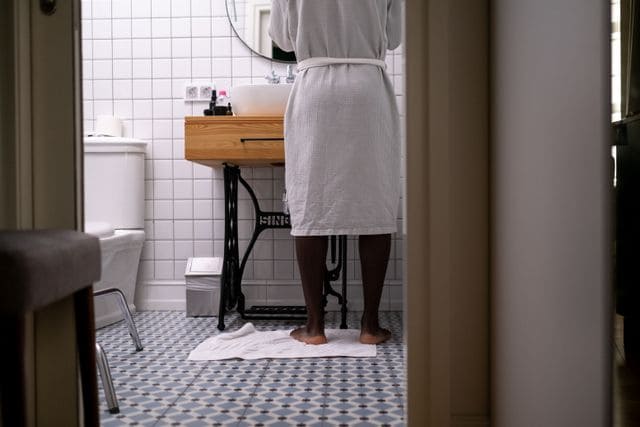
Bathrooms combine wet and slippery floors, narrow spaces, and frequent sit-to-stand movements, which makes them a common setting for falls among older adults. A safer bathroom usually starts with securely mounted grab bars, non-slip surfaces, better lighting along the path to the bathroom, and keeping walkways clear — it does not require a full renovation. This page is a practical checklist for families, not medical care. Product injury statistics, where used, describe patterns associated with products and cannot prove that a product caused a fall.
Why Bathroom Risk Is High
Most bathroom falls are not caused by a single problem. They are the result of several factors overlapping in a small, unforgiving space:
- Wet and slippery surfaces. Water on tile, porcelain, or a smooth floor reduces traction underfoot.
- Hard fixtures. A sink, tub edge, or toilet is not a soft landing surface.
- Sit-to-stand transfers. Getting on and off the toilet, stepping over a tub wall, or lowering into a shower all involve moments where balance shifts and support matters.
- Nighttime trips. The path from the bed to the bathroom may cross a dark hallway, and grogginess or low blood pressure upon standing can make that trip harder.
- Narrow layout. There is often little room to step around a hazard or catch yourself on a nearby surface.
Public health agencies including the National Institute on Aging (NIA) recommend room-by-room fall prevention precisely because different rooms carry different risks. The bathroom deserves its own attention.
The Bathroom Checklist
This checklist is organized by what tends to help most families first. Every home is different — you know your family member's situation best.
Start here
- Install grab bars near the toilet — wall-mounted, securely anchored to studs, positioned where they are easy to reach when sitting down or standing up.
- Install grab bars in the shower or tub — where the person can hold them while stepping in, standing, or lowering down.
- Use non-slip mats or strips — inside the tub or shower, and on the floor just outside.
- Clear the walkway — remove loose rugs, cords, and clutter between the bed and the bathroom.
- Add nightlights — motion-activated or plug-in lights along the bed-to-bathroom path.
Next step
- Consider a shower chair or transfer bench — for anyone who finds standing in the shower tiring or unsteady.
- Consider raised toilet support — a raised seat or toilet safety frame can make sitting and standing easier.
- Keep toiletries easy to reach — no bending low or stretching high for shampoo, soap, or towels.
- Wipe up standing water — after each shower or bath, and after handwashing.
- Consider a handheld showerhead — makes it easier to bathe while seated.
About grab bars
A towel bar is not a grab bar. Towel bars are designed to hold the weight of a towel, not a person. If someone reaches for a towel bar during a slip, it may pull out of the wall. Grab bars are specifically designed, rated, and installed for body weight.
Products vs. Habits
Bathroom safety has two sides: what you install, and what you do.
Hardware and layout — grab bars, non-slip surfaces, shower chairs, raised toilet seats, and lighting — form the physical layer. These changes stay in place and help every time.
Habits and awareness — wiping up water, turning on the nightlight before walking, keeping the path clear, asking for help with difficult transfers — form the daily layer. These habits cost nothing and compound over time.
Both matter. The most useful grab bar does not help if the person does not reach for it, and the clearest path is not safe if the floor is wet.
If a fall has already happened, or if standing, sitting, or stepping over the tub edge has become noticeably harder, the NIA recommends talking with a doctor or occupational therapist. They can assess balance, review medications that may affect steadiness, and suggest changes specific to the person's situation. An in-home occupational therapy assessment can be especially useful because it looks at how the person actually moves through their own bathroom.
For a printable version of a general home fall-prevention checklist, the CDC STEADI program provides free resources designed for older adults and their families.
How Injury Data Informs This Room
The suggestions in this checklist are not arbitrary. They reflect patterns that show up in public injury surveillance data — including the CPSC's NEISS database, which tracks product-associated injuries treated in U.S. hospital emergency departments.
We describe these patterns qualitatively rather than citing specific numbers, because a number without context can mislead. For example, the fact that a product category appears in many injury records does not mean that the product is inherently dangerous — it may simply be very widely used. Understanding that distinction is key to reading injury data responsibly.
If you want to understand how NEISS works — how a sample of hospitals produces national estimates, what "associated with" means, and how it differs from recalls — read our plain-English guide: What Is NEISS? How to Read CPSC Product Injury Numbers.
How SafeCheck Home Fits In
SafeCheck Home is designed to help families work through checklists like this one, room by room.
- Room-by-room checklists — create a bathroom checklist (and one for every other room) with suggested risk areas based on injury data patterns.
- Category search — look up a product category, such as grab bars or shower chairs, and see injury context with clear caveats.
- Family member profiles — set the age of the person you are caring for, and receive age-tailored safety alerts.
Core features are free on the SafeCheck Home homepage. For details on how we handle your data, see our Privacy Policy.
Related Guides
- What Is NEISS? How to Read CPSC Product Injury Numbers — understand the data behind product safety.
- Fall Prevention at Home: A Room-by-Room Checklist for Older Adults — whole-home fall prevention beyond the bathroom.
- Stairs, Floors & Rugs: Fall Prevention — walking surfaces beyond the bathroom.
- Crib Safety Checklist: Safer Sleep for Babies — a safe-sleep checklist for parents.
- SafeCheck Home — search injury data by product category, build room-by-room checklists, and make informed decisions for your family.
Frequently Asked Questions
Why are bathrooms risky for older adults?
Bathrooms combine several fall risk factors in a small space: wet and slippery surfaces, hard fixtures, limited room to move, and frequent sit-to-stand transfers at the toilet, tub, and shower. Nighttime trips to the bathroom add another layer of risk because lighting may be low and the person may be groggy.
What bathroom changes help first?
Most families start with securely mounted grab bars near the toilet and in the shower or tub, non-slip mats or strips on wet surfaces, and brighter lighting along the path from the bed to the bathroom. Clearing clutter, loose rugs, and cords from the walkway is another high-impact step.
Can a towel bar be used as a grab bar?
No. A towel bar is designed to hold the weight of a towel, not the weight of a person. If someone grabs a towel bar during a fall, it may pull away from the wall. Grab bars are specifically designed and installed to support a person's weight.
When should we call a doctor or occupational therapist?
If a fall has already happened, or if standing up, sitting down, or stepping over the tub edge has become difficult, it is a good idea to talk with a doctor or occupational therapist. They can assess balance, review medications, and recommend specific changes for the person's situation.
How does SafeCheck Home help with bathroom safety?
SafeCheck Home lets families create room-by-room safety checklists, including a bathroom checklist with suggested risk areas based on injury data patterns. It also lets you search product categories to understand injury context. Core features are free.
Sources
- National Institute on Aging — Preventing Falls at Home: Room by Room
- CDC STEADI — Stopping Elderly Accidents, Deaths & Injuries
- SafeCheck Home — What Is NEISS?
- SafeCheck Home
This article is for informational purposes only. It is not medical advice, a substitute for professional assessment, or a guarantee against falls. Always consult a qualified healthcare provider for specific medical or mobility concerns.