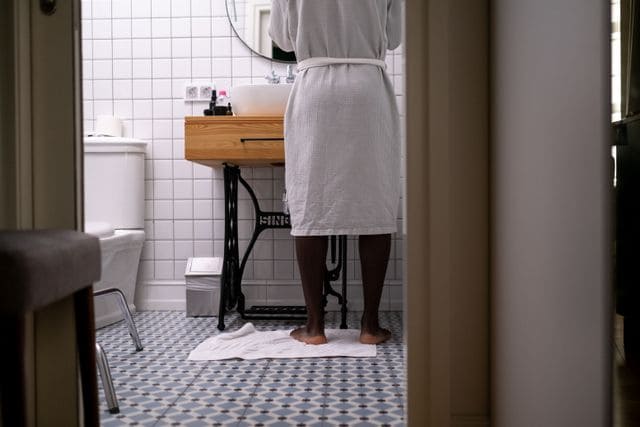
Getting on and off the toilet challenges balance for many older adults — low seats, wet floors, tight spaces, and sudden standing. Practical first steps: securely mounted grab bars beside the toilet (never towel bars), a raised or comfort-height seat that still lets feet rest flat, a dry floor, walker within reach if used, and night lighting on the bed-to-bathroom path. In SafeCheck Home's weighted NEISS views, toilets often rank among top home product categories for older adults and show a high admission rate in that export — useful for prioritizing the toilet area, not for proving a toilet caused a fall. Scenario clusters below are pattern views with caveats. Practical educational guidance, not medical care; data method: What Is NEISS?
Why toilets rank for older adults
The toilet is a high-frequency transfer point: sitting down, standing up, turning, reaching for clothing or support, and often doing it in low light or on a wet floor. Support at this one location can protect many daily trips.
The category row below comes from SafeCheck Home's internal weighted NEISS view for TOILETS (code 649) in the seniors slice. It is a category-level national estimate from a probability sample — not raw hospital totals and not an official CPSC ranking.
| Audience slice | Rank in this export | Sample cases | National estimate | Admission rate |
|---|---|---|---|---|
| Seniors | #6 | 2,943 | ~137,904 | 38.0% |
The 38.0% admission rate is a severity signal in this weighted view. It is a reason to prioritize toilet-area support, not proof that toilets cause admissions and not a claim that 38% of toilet falls result in admission.
These figures describe injuries associated with toilets — not proof that a toilet was defective or caused a fall. For tub, shower, mats, and whole-room checks, read Bathroom Safety for Older Adults; this page deliberately deepens the toilet only.
Injury patterns — how toilet falls show up (cluster view)
The five rows below group recurring emergency-department narratives from SafeCheck Home's seniors Top5 pattern export for toilets. Use them to prioritize support and lighting, not to diagnose a person or label a toilet as unsafe by brand or type.
| Injury | What happens | Object chain | Cluster sample | Cluster national estimate | Prevention tip |
|---|---|---|---|---|---|
| Head injury / concussion / scalp laceration | Fall while using or getting off the toilet; head hits toilet, bathtub, or nearby objects | Toilet + Bathtub | 831 | ~35,324 | Install weight-bearing grab bars beside the toilet; controlled sit-to-stand (STEADI / MedlinePlus). |
| Other / weakness or loss-of-consciousness language | Weakness or loss of consciousness while using the toilet → fall to floor; may be unable to get up | Toilet + Floor | 500 | ~22,127 | Rise slowly; rest if dizzy; raised seat + grab bars; seek clinical care for unexplained syncope/dizziness — do not diagnose here. |
| Head contusion / abrasion | Faint or lose consciousness on the toilet → fall forward/off onto the floor | Toilet + Floor | 267 | ~10,614 | Grab bars + raised seat; don't get up suddenly after urinating (MedlinePlus); clinical follow-up if fainting. |
| Fracture (hip / spine — lower trunk language) | Fall while getting up from or using the toilet → hip or spine fracture | Toilet + Floor | 186 | ~8,909 | Grab bars; keep floor dry; assist unsteady transfers (STEADI / NIA); seek care after serious falls. |
| Fracture (rib / spinal — upper trunk; often women in cluster language) | Fall from toilet while getting up or reaching for support; walker may be nearby | Toilet + Walker | 155 | ~7,354 | Grab bars within reach; keep walker close if used; avoid overreaching. |
How to read this table: These figures are scenario cluster sample counts and national estimates from SafeCheck Home's Top5 pattern export for seniors toilets — a cluster / pattern view, not proof of cause and not a simple percentage of all senior toilet-associated injuries without caveats. Always distinguish category sample / national estimate (table above) from cluster sample / cluster estimate. Narratives mentioning medical conditions or nursing homes are cluster language — this page does not diagnose. Associated with ≠ caused by. Educational only.
Toilet-area checklist — grab bars, seat height & transfers
Guidance from CDC STEADI, MedlinePlus, and the NIA points to the same priorities: stable support, a workable seat height, dry footing, and enough light to move safely.
- Install weight-bearing grab bars beside the toilet. A side-wall bar is common; add a rear bar when the layout allows it. Bars must be properly anchored into studs or reinforced blocking.
- Never rely on towel bars, toilet-paper holders, or suction cups. They are not designed to arrest a fall. MedlinePlus makes the same distinction.
- Use qualified help when placement is unclear. An occupational therapist can match support to the person; a qualified installer can assess walls and mounting.
- Consider a raised toilet seat, comfort-height toilet, or safety frame if transfers are hard. Choose secure attachment and stable armrests or frame supports.
- Check seat height against the person. Feet should rest flat. Too high leaves feet dangling; too low forces an extreme bend.
- Practice controlled sit-to-stand: scoot forward → feet flat → lean → push through the legs with light support on the bars or frame → pause once upright. Related habits: Chair Fall Prevention.
- Keep the floor dry and clear. Wipe standing water, remove loose rugs near the transfer path, and keep clutter out of reaching distance.
- Keep a walker within easy reach if one is used. Avoid twisting or stretching across the room to retrieve it.
- Light the night path. Motion or low-level lighting from bed to bathroom reduces groping for switches and walking through shadowed obstacles. See Bedroom Fall Prevention.
- Ask about OT / home assessment after repeated falls, dizziness on standing, or fainting. This page is educational and does not diagnose.
- Don't grab a towel bar or paper holder because it happens to be close.
- Don't rush standing after sitting, especially if light-headed.
- Don't overreach for toilet paper, clothing, or a walker when support is out of position.
- Don't treat this as tub/shower guidance. For bath mats, shower seats, and wet-room bars, use the whole-bathroom guide.
Soft floors and rugs belong to the larger walking-surface plan: see Stairs, Floors & Rugs. For the full room-by-room map, see Fall Prevention at Home.
Where this fits with our other guides
- Bathroom Safety for Older Adults — the whole room, including tub/shower transfers and mats.
- Fall Prevention at Home — the whole-home senior checklist.
- Bedroom Fall Prevention — bed transfers and the lit night path.
- Stairs, Floors & Rugs — rugs, cords, lighting, and walking surfaces.
- Chair Fall Prevention — stable seats and sit-to-stand habits.
- What Is NEISS? — sampling, weighting, and association caveats.
How SafeCheck Home fits in
SafeCheck Home helps families turn injury context into practical, age-appropriate checks around the home.
- Category search — explore NEISS-based views for 1,000+ CPSC product categories, with caveats about association versus causation.
- Room-by-room checklists — work through bathroom transfers, night paths, floors, and seating in small steps.
- Age-tailored alerts — adapt reminders for older adults and children as needs change.
Core features are free to download and use. SafeCheck Home complements — but does not replace — STEADI / NIA / MedlinePlus / OT guidance, recalls, or clinical care. Our free and privacy guide explains who the app is for. Data handling is described in the Privacy Policy, and site terms are in Terms of Service.
Related guides
- Bathroom Safety for Older Adults — whole-bathroom wet-room checks.
- Fall Prevention at Home — room-by-room senior priorities.
- Bedroom Fall Prevention for Older Adults — bed height and night paths.
- Stairs, Floors & Rugs — walking-surface fall prevention.
- Chair Fall Prevention — everyday seats and sit-to-stand transfers.
- Footwear Fall Prevention for Older Adults — secure slippers and safer walking surfaces.
- What Is NEISS? — how to read category and cluster data safely.
- Is SafeCheck Home Free? — pricing, data collection, and who the app is for.
- SafeCheck Home — product category search and room-by-room checklists.
Frequently asked questions
Is this the same as your bathroom safety checklist?
No. The bathroom safety checklist covers the whole bathroom (tub/shower, mats, lighting, clutter). This page deepens toilet transfers — grab bars, seat height, and toilet-related injury patterns.
Where should toilet grab bars go?
Common setups include a side-wall bar for sitting and standing and, when the layout allows, a rear bar for turning or clothing. Bars must be weight-bearing and properly anchored — not towel bars or suction cups. An occupational therapist or qualified installer can match placement to the person and the walls.
Do we need a raised toilet seat?
Raising seat height can make sitting and standing easier for some people. Choose a securely attached seat or frame with stable support; feet should rest flat. Too high (dangling feet) or too low (extreme bend) both work against balance — ask an OT or clinician if unsure.
Why is the admission rate so high for toilets in your seniors export?
In this weighted NEISS view, toilets show a 38.0% admission rate among sampled senior toilet-associated ED visits — a severity signal for prioritizing support, not proof toilets cause admissions. See What Is NEISS?
Can I treat scenario cluster numbers as a percent of all senior toilet injuries?
No. Cluster counts are pattern groupings. Always label sample vs cluster vs national estimate; associated with ≠ caused by. Unexplained fainting or repeated falls need clinical advice — this page is not a diagnosis tool.
Sources
- CDC STEADI — Check for Safety (PDF) and STEADI Patient & Caregiver Resources: home fall checks and educational support.
- MedlinePlus — Bathroom safety for adults: bathroom support, grab bars, and seat-height guidance.
- National Institute on Aging — Preventing Falls at Home: Room by Room: room checks, lighting, paths, and home assessment framing.
- SafeCheck Home — What Is NEISS?: how hospital samples become weighted national estimates and why association is not causation.
- SafeCheck Home's internal weighted NEISS view for TOILETS (code 649) and its seniors Top5 pattern export, checked on November 3, 2026. Figures are category or cluster views — not official CPSC rankings, defect findings, or clinical diagnoses.
This article is for informational purposes only. It is not medical advice and is not a substitute for professional guidance from your clinician, occupational therapist, product manufacturer, installer, or emergency instructions. Toilet-area changes reduce selected hazards — they do not prevent all falls or injuries. Always follow product instructions and consult qualified professionals.