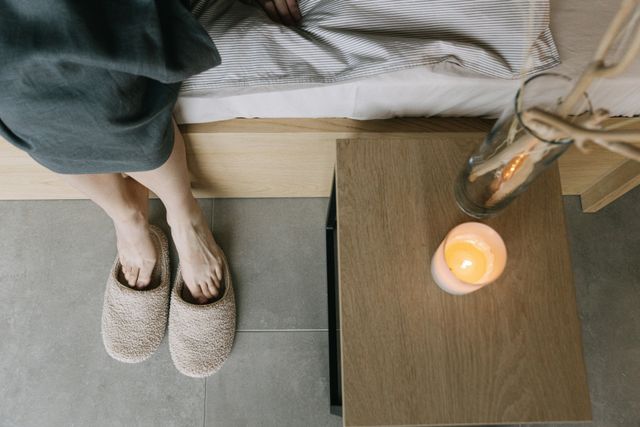
A safer bedroom usually starts with the bed transfer: a stable height that lets both feet sit flat with knees near 90 degrees, a slow sit-first pause before standing, and a clear, lit path to the bathroom. Keep glasses, a phone or alert device, and a flashlight within reach. Adult portable bed rails can help some transfers but also create serious entrapment risks — check recalls, follow installation rules, and ask a clinician or occupational therapist before adding one. Practical educational guidance, not medical care. Scenario clusters below are mixed-age pattern views from SafeCheck Home's Top5 export — useful for prioritizing bedroom checks, not for proving a bed caused an injury or for reading cluster counts as a simple percent of all senior bed injuries. Method caveats: What Is NEISS?
Why beds matter in seniors' home injury patterns
The bed is a daily transfer point, and the dark walk that follows is part of the same system. In SafeCheck Home's weighted NEISS view of seniors' home product categories, the category BEDS OR BEDFRAMES, OTHER OR NOT SPECIFIED ranked second, after floors. That view was based on 11,165 sample hospital cases and produced a national estimate of about 510,479 emergency department-treated injuries, with a 33.0% admission rate. The figures come from a statistically weighted probability sample; they are not raw hospital totals or an official CPSC ranking.
Injuries associated with beds or bedframes were recorded together with those products — they were not necessarily caused by them. The estimate does not prove that any bed was defective or that a fall began at the bed. Use patterns to prioritize checks; floors remain first in this view. Read how hospital cases become national estimates.
Injury patterns — how bed falls show up (cluster view)
The five rows below are recurring ED narratives from SafeCheck Home's Top5 pattern export for beds/bedframes (product code 4076). They prioritize checks, not to rank danger or diagnose.
| Audience focus | Injury | What happens | Object chain | Cluster sample | Cluster national estimate | Prevention tip |
|---|---|---|---|---|---|---|
| Seniors (priority) | Head injury (internal / laceration / contusion) | Fall out of / while leaving bed; head hits floor or furniture | Bed + Floor | 6,044 | ~194,090 | Use workable bed height, clear landing, and night light (NIA / STEADI); ask a clinician about repeated falls. |
| Mixed (soft note) | No injury / minor unspecified | Fall out of bed onto floor/pad; often minor/none | Bed + Floor | 2,330 | ~97,469 | Clear the path; child patterns belong on the kids bed & bunk guide. |
| Seniors (priority) | Back pain / hip pain | Strain rising from bed | Bed | 1,429 | ~63,716 | Keep feet flat, sit-pause-stand, and use approved support; see chair transfers. |
| Kids-weighted soft (bridge) | Facial laceration | Fall/slide off bed; face hits frame/headboard | Bed + Bed frame/Headboard | 1,215 | ~39,631 | See the kids bed & bunk guide; not a senior transfer pattern. |
| Seniors (priority) | Hip fracture | Fall from/while leaving bed; hip fracture | Bed + Floor | 739 | ~33,116 | Lower fall height and clear path when appropriate; seek care after serious falls — not default APBR; see rails caution. |
How to read this table: These figures are scenario cluster sample counts and national estimates from SafeCheck Home's Top5 pattern export for beds/bedframes — a cluster / pattern view, not proof of cause and not a simple percentage of all senior bed-associated injuries. Kids and seniors beds Top5 lists are the same mixed-age list; Audience focus filters this page's habits. Cluster samples may exceed the seniors category sample (11,165) because they group mixed-age narratives. Always distinguish category sample / national estimate (11,165 / ~510,479) from cluster sample / cluster estimate. Associated with ≠ caused by. Educational only; not medical advice.
Bed height & transfer checklist
NCOA's practical rule is to choose a height that lets a person sit with both feet flat and knees about 90 degrees; many people find the mattress top around 20 to 23 inches from the floor works, but fit and a stable frame matter more. MedlinePlus and NIA also emphasize safer transfers, reachable essentials, and a clear route.
- Test the sit edge. Both feet should rest flat, knees near 90 degrees, with stable support within reach.
- Adjust height only without destabilizing the bed. Too high or too low both make transfers harder; keep the frame and mattress supported as designed.
- Sit first, pause, then stand slowly. Give balance a moment to settle before the first step.
- Keep essentials within reach. Glasses, hearing aids, a phone or alert device, water, and a flashlight should not require leaning far.
- Clear the transfer zone. Keep mobility aids in reach and remove clutter that could catch a foot or cane.
- Check the mattress edge. Replace a deep-sinking mattress only with one compatible with the frame and any approved assistive device.
- Ask about assist handles before improvised fixes. NCOA mentions assist handles and transfer poles to explore with a professional.
- Consider same-floor sleeping when stairs are hard. MedlinePlus suggests this arrangement; see our stairs guide.
If transfers have changed after an illness, surgery, medication change, or fall, ask a clinician or occupational therapist for an individual assessment. This checklist does not replace that guidance.
Night path — bed to bathroom
Low light, grogginess, cords, rugs, and clutter can turn the bed-to-bathroom route into a fall path. Treat it as part of the bedroom, not only the bathroom.
- Put light control near the bed. NIA recommends night lights or switches close to the bed; keep a flashlight as backup.
- Light the whole route. Cover the hallway, doorway, corners, thresholds, and the first step into the bathroom.
- Clear every walking section. Remove laundry, shoes, pet bowls, cords, and other obstacles from the route.
- Secure or remove rugs. Use approved backing or tape; remove any rug that curls or slides.
- Make thresholds predictable. Mark a raised edge with contrast and repair loose flooring before it catches a toe.
This page ends at the bathroom door. For wet surfaces, grab bars, toilet and shower transfers, see Bathroom Safety for Older Adults.
Adult portable bed rails — caution first
An adult portable bed rail can help some people transfer, but it can also create a serious entrapment hazard. CPSC and FDA warn about head, neck, and chest entrapment and related deaths. CPSC says about 90% of reported injuries associated with APBRs involve head, neck, or chest entrapment, identified 284 entrapment deaths from 2003 through 2021, and has recalled more than 3 million APBRs through nine recalls or warnings since 2021.
Treat a rail as a potential assistive device — not a default purchase and never a restraint. CPSC issued a new federal mandatory safety standard in 2023. If a professional recommends a rail, follow current instructions and check the model first.
- Get an assessment first. Ask a clinician or occupational therapist whether a rail is appropriate, especially with dementia or limited mobility.
- Check the model. Search SaferProducts.gov and CPSC Recalls; confirm current-standard compliance.
- Eliminate hazardous gaps. Press it firmly against the mattress, use any required retention device, and leave at least 12.5 inches between the rail and headboard or footboard as CPSC advises.
- Keep furniture away. Do not create another gap or climbing hazard beside the bed.
- Do not combine side-by-side rails unless the manufacturer explicitly designs and instructs for that use.
- Never climb over or modify a rail. Recheck fit after any mattress change; reassess as strength, cognition, medication, or mattress height changes.
- Don't use a rail as a restraint.
- Don't improvise with boards, bars, or furniture.
- Don't assume an older rail meets the current standard.
- Don't leave a known gap “just for tonight.”
Where this fits with our other guides
The whole-home fall-prevention checklist maps the major rooms. This page goes deeper on the bedroom: bed height, transfers, the night path, and adult bed-rail caution. For wet-room hardware and bathroom transfers, use our bathroom guide. For hallways, rugs, and stair checks, see Stairs, Floors & Rugs. The kids page is a different audience and product set: Kids Bed & Bunk Safety Checklist.
How SafeCheck Home fits in
SafeCheck Home helps families turn injury context into practical, age-appropriate checks around the home.
- Category search — explore NEISS-based views for 1,000+ CPSC product categories, with caveats about association versus causation.
- Room-by-room checklists — work through bedroom, bathroom, hallway, and other home areas in small steps.
- Age-tailored alerts — adapt reminders for older adults and children as needs change.
Core features are free to download and use. SafeCheck Home complements — but does not replace — NIA/STEADI/CPSC guidance, recalls, or clinical care. Our free and privacy guide explains who the app is for, and the Privacy Policy explains data handling.
Related guides
- Bathroom Safety for Seniors — wet-room transfers, grab bars, and nonslip surfaces.
- Toilet Fall Prevention for Older Adults — toilet-specific grab bars, seat height, and transfers.
- Footwear Fall Prevention for Older Adults — secure slippers, heel support, and indoor traction.
- Fall Prevention Checklist — the whole-home room-by-room map.
- Stairs, Floors & Rugs — walking-surface fall prevention for older adults.
- Chair Fall Prevention — stable seating and safer sit-to-stand transfers.
- Coffee Table Edge Safety — clear low tables from senior walking paths.
- What Is NEISS? — hospital samples, national estimates, and data caveats.
- Is SafeCheck Home Free? — pricing, data collection, and who the app is for.
- Kids Bed & Bunk Safety — child and bunk bed guidance, not senior transfers.
- SafeCheck Home — product category search and room-by-room checklists.
Frequently asked questions
What is a practical bed height for older adults?
A common rule of thumb (NCOA): sit on the edge with both feet flat and knees about 90 degrees. Many people find the top of the mattress around 20 to 23 inches from the floor works, but individual fit and a stable frame matter more than one number.
How should we light the path from bed to bathroom?
Put night lights or light switches close to the bed, keep a flashlight nearby, and light the hallway or route (NIA). Keep the path clear of clutter, cords, and unsecured rugs. Wet-room grab bars and nonslip surfaces are covered on the bathroom safety checklist.
Are adult portable bed rails safe for seniors?
They can assist some people and also create serious entrapment hazards. CPSC and FDA warn about head, neck, and chest entrapment and related deaths. Check that any rail is not recalled and meets the current mandatory standard; install without dangerous gaps; do not use as a restraint; ask a clinician or occupational therapist first — especially with dementia or limited mobility.
Can I treat bed scenario cluster numbers as a percent of all senior bed injuries?
No. Cluster counts are mixed-age pattern groupings. Always label sample vs cluster vs national estimate; associated with ≠ caused by. Senior-priority rows (head injury, transfer strain, hip fracture) inform this page; child face-to-frame patterns belong on the kids bed & bunk guide.
How is this different from the bathroom or whole-home fall checklists?
The whole-home page maps rooms. The bathroom page covers wet surfaces and grab bars. This page deepens bedroom bed transfers, height, the night path, and adult bed-rail caution. Families often need more than one guide.
Sources
- NCOA — Bedroom Safety Guide: bed-height rule of thumb, slow transfers, and professional assistive-device options.
- National Institute on Aging — Preventing Falls at Home: Room by Room: bedroom lighting, reachable items, rugs, and clutter.
- MedlinePlus — Preventing Falls: room arrangement and practical home fall-prevention steps.
- CDC STEADI — Check for Safety (PDF) and the CDC STEADI hub: home checks and clinician resources.
- CPSC — Adult Portable Bed Rails: entrapment warnings, deaths and recall figures, installation spacing, and model checks.
- CPSC — New Federal Mandatory Safety Standard for Adult Portable Bed Rails: current mandatory standard.
- FDA — Safety Concerns About Adult Portable Bed Rails: higher-risk situations and warnings.
- SaferProducts.gov, CPSC Recalls, and Recalls.gov: check a specific model you own.
- SafeCheck Home — What Is NEISS?: sampling, weighting, and “associated with” versus “caused by.”
- SafeCheck Home's Top5 NEISS pattern export for BEDS OR BEDFRAMES, OTHER OR NOT SPECIFIED (product code 4076), checked on November 3, 2026. They are mixed-age scenario clusters and estimates, not age-slice totals or official CPSC ranking.
- SafeCheck Home's internal weighted NEISS view for BEDS OR BEDFRAMES, OTHER OR NOT SPECIFIED, checked on November 3, 2026. The 11,165 sample cases, about 510,479 estimated ED-treated injuries, and 33.0% admission rate are category-level figures from that view, not an official CPSC ranking and not pattern-level counts.
This article is for informational purposes only. It is not medical advice and is not a substitute for professional assessment. Always consult qualified healthcare providers for mobility, cognitive, medication, bed-rail, or transfer decisions. Good setup reduces selected hazards — it does not prevent all falls.