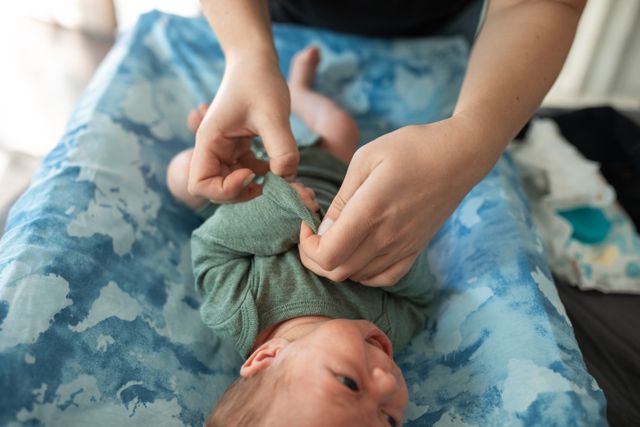
Falls from elevated diaper-change surfaces can be serious. Keep one hand on your baby whenever they are on a changing table, buckle any safety strap if the product has one, and never leave a child unattended — even for a moment, even if strapped. A strap is a backup, not a substitute for continuous supervision; keep wipes, diapers, and creams within your reach so you do not turn away. Prefer a sturdy table or contoured pad with barriers on the sides. CPSC's Nursery Products Annual Report 2025 estimates about 5,400 ED-treated injuries associated with changing tables among children under 5 in 2024 — useful for prioritizing change-surface habits, not for proving a table caused an injury. This is practical educational guidance, not medical care; associated with ≠ caused by. See the CPSC Baby Changing Products FAQ, HealthyChildren, and What Is NEISS?
Everyday changing-table checklist (never leave)
These habits take only a few seconds, but they address the main job: keeping a wiggling baby from reaching an edge or being left alone on an elevated surface.
- Stage supplies within your reach first. Put diapers, wipes, creams, and a change of clothes where you can reach them without turning away; keep sharp or small objects out of your child's reach.
- Keep one hand on your baby on any elevated surface. Treat physical contact as the default until the change is finished and both feet are back on the floor.
- Buckle the strap if the product has one. Use it as designed, but do not call it hands-free supervision.
- Never leave a child unattended — even for a moment. If the doorbell, phone, sibling, or kettle needs attention, take the baby with you or finish the change first.
- Prefer barriers on elevated surfaces. A sturdy table with side barriers or a contoured pad with barriers can help reduce rolling, but it does not replace your hand and attention.
- Use a clean floor mat when practical. A floor change removes the fall height; continuous supervision still matters.
- Keep powders and disposable-diaper plastic liners out of reach. Follow HealthyChildren's caution around these changing supplies and store them away from your child.
- Treat the change area as part of your childproofing plan. Keep cords, shelves, and reachable hazards away from the surface. See Childproofing Checklist.
This is educational guidance, not a substitute for advice from your pediatrician or other qualified clinician.
Buying, secondhand, accessories & the federal standard
CPSC's baby changing products rule, 16 C.F.R. part 1235 (incorporating ASTM F2388), took effect June 26, 2019. CPSC describes its purpose as reducing falls from changing tables, structural and mechanical failures, instability and entrapment, and suffocation. Details are in the CPSC Baby Changing Products FAQ.
In plain language, that product family includes freestanding changing tables, changing-table accessories for cribs or play yards, add-on changing units, and contoured changing pads. A flat, non-contoured diaper-bag mat is outside that rule's definition — so inspect it separately and supervise closely.
- Prefer compliant units. For new or secondhand products, look for evidence of the current standard and check for recalls before use.
- Inspect barriers, stability, and parts. Ensure rails and contours remain secure, legs lock or rest evenly, and no hardware or pad parts are missing.
- Keep a dresser-combo tip-over check separate. Anchoring tall dressers addresses a different furniture pattern; see Furniture Tip-Over Prevention.
- Keep sleep separate. Change surfaces are not safe sleep spaces; see Crib Safety Checklist.
How Nursery Injury Data Fits In (NEISS / CPSC Context)
The CPSC's Nursery Products Annual Report 2025 publishes NEISS-based national estimates for children under 5. Use the changing-table category estimate below to prioritize habits, not to diagnose a product or prove causation.
| Fact | Value |
|---|---|
| Changing Tables — 2024 ED estimate (under 5) | 5,400 |
| Changing Tables — 2023 | 5,100 |
| Changing Tables — 2022 | 6,000 |
| TOTAL nursery products — 2024 | ~70,000 |
| Top four share of 2024 estimated injuries | 62% |
Labeled 2024 nursery-wide pattern facts:
- Top four categories (high chairs, cribs/mattresses, strollers/carriages, infant carriers) = 62% of 2024 estimated injuries.
- Falls = leading cause (2024).
- About 79% involved head, ears, eyes, face, or mouth.
- Internal organ injury / contusion-abrasion / laceration ≈ 69%.
- ≈ 94% treated and released.
- Rate ≈ 380 per 100,000 children under 5 (for the ~70,000 total).
ED estimates and fatality narratives are separate. Changing Tables are a mid-pack nursery ED category and a tiny share of reported nursery deaths (Table 3: 2 total deaths associated with Changing Tables in 2020–2022; average annual: 1). Keep never-leave supervision as the practical response.
These figures are 2024 national estimates from the CPSC Nursery Products Annual Report 2025, based on NEISS emergency department data for children under 5. They describe injuries associated with changing tables or other nursery products present or in use at the time of treatment — not proof that the product caused the injury. National estimates from a probability sample carry statistical uncertainty. Educational only; not medical advice. See What Is NEISS?
Where this fits with our other guides
- Childproofing Checklist — whole-home hazards and room-by-room priorities.
- Crib Safety Checklist — Alone, Back, Bare-is-best sleep guidance.
- Play Yard Safety Checklist — setup, Bare is Best, and accessory separation.
- High Chair Safety Checklist — restraints and mealtimes.
- Stroller & Carrier Safety Checklist — harnesses, brakes, and carrier placement.
- Baby Gate Safety Checklist — hardware-mounted stair protection.
- Furniture Tip-Over Prevention — anchor dressers and TVs; a different pattern from edge falls.
- What Is NEISS? — how estimates are made and how to read caveats.
Related guides
- Childproofing Checklist: Room by Room — practical checks across the home.
- Crib Safety Checklist: Safer Sleep for Babies — safe-sleep basics.
- Play Yard Safety Checklist — Bare is Best for play-yard sleep.
- High Chair Safety Checklist — safer mealtimes.
- Stroller & Carrier Safety Checklist — safer outings.
- Baby Gate & Safety Gate Checklist — stair-top hardware mounts.
- Furniture Tip-Over Prevention Checklist — anchoring guidance.
- What Is NEISS? — understand the data behind product safety.
- Is SafeCheck Home Free? — pricing, data collection, and who the app is for.
- SafeCheck Home — search injury data by product category and build room-by-room checklists.
Frequently asked questions
Is the changing-table safety strap enough if I step away for one second?
No. Buckle the strap if provided, but never leave a child unattended on a changing table — even strapped. Keep one hand on the baby and stage supplies within reach so you do not turn away (HealthyChildren-aligned).
What does “injuries associated with changing tables” mean?
The CPSC Nursery Products Annual Report 2025 estimates about 5,400 ED-treated injuries associated with changing tables among children under 5 in 2024, within roughly ~70,000 total nursery-product-associated ED injuries that year. “Associated with” means the product was present or in use at the time of treatment — it does not prove the table caused the injury. See What Is NEISS?
Should we change diapers on the floor instead of a table?
Many families use a clean floor mat when practical. Elevated tables are convenient but raise fall height — continuous supervision still matters on any surface. Choose what your household can supervise consistently.
Our changing table is built into a dresser — is that tip-over risk?
Use this page’s never-leave change habits on the elevated surface. Anchoring tall dressers / preventing tip-overs is a different pattern — see Furniture Tip-Over Prevention Checklist.
Can the baby sleep on the changing pad or accessory?
No. Change surfaces are not safe sleep spaces. Alone, on the back, in a crib — bare is best. See Crib Safety Checklist.
Sources
- CPSC — Baby Changing Products FAQ
- CPSC — Nursery Products Annual Report 2025 (PDF)
- AAP HealthyChildren — Changing Table Safety
- SafeCheck Home — What Is NEISS?
- SafeCheck Home — Childproofing Checklist
- SafeCheck Home — Crib Safety Checklist
- SafeCheck Home — Furniture Tip-Over Prevention Checklist
This article is for informational purposes only. It is not medical advice, a diagnosis, or a substitute for professional guidance from your pediatrician or other qualified clinician. Always follow the manufacturer's instructions for your product and consult qualified healthcare providers for your child's specific needs.
How SafeCheck Home fits
SafeCheck Home is built for parents and caregivers who want to move from injury context to practical checks. It provides NEISS-powered category injury views across 1,000+ CPSC product categories, room-by-room safety checklists, and age-tailored alerts for children and older adults.
- Core features are free to download and use.
- It collects minimal personal data, has no third-party ads, and does not sell data for advertising.
- It provides educational safety information; associated with ≠ caused by.
- It complements — but does not replace — CPSC / AAP HealthyChildren guidance, recalls, or clinical care.
Learn more in Is SafeCheck Home Free?, the Privacy Policy, and the Terms of Service.