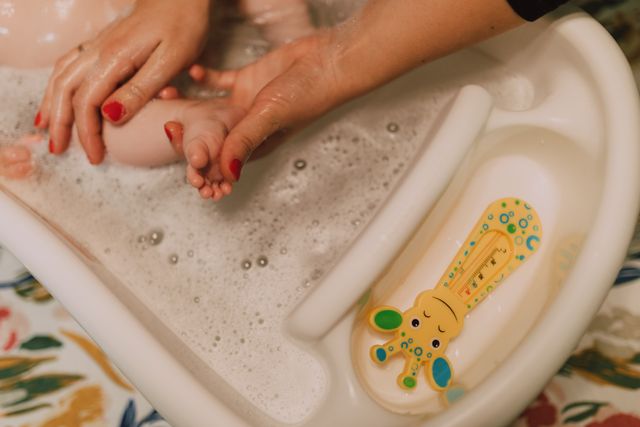
A bath seat or baby tub is a bathing aid, not safety device — never leave, stay within arm’s reach, and take the baby if you leave. Stage supplies first; empty water afterward; babies can drown in very little water. CPSC’s Nursery Report 2025 has no 2024 national ED point estimate for Baby Baths/Bath Seats/Bathinettes (Table 2 shows ---); do not invent a volume. Reported-death rows are a separate labeled signal. Educational guidance, not medical care or a CPR class; associated with ≠ caused by. See seats FAQ, tubs FAQ, Pub 210, and NEISS guide.
Everyday infant-bath checklist (never leave / arm’s reach)
These habits address the main job: keeping an adult’s attention and hands within rescue distance from the first inch of water to the last. For the broader room context, see the Childproofing Checklist.
- Remember: bathing aid ≠ safety device. Seats and tubs are not babysitters (CPSC Publication 210 / infant tub release).
- Never leave unattended. That means not even for a moment — take the baby with you if you must leave.
- Stay within arm’s reach at all times. Physical reach matters even when the baby is in a seat or tub.
- Do not rely on another young child to supervise. A sibling cannot substitute for a responsible adult.
- Stage supplies first. Keep towels, soap, and clean clothes within arm’s reach so you never turn away.
- Empty the water after use. Also do not leave a child unattended while the tub or basin is filling.
- Check water temperature. CPSC Publication 210 gives an educational range of about 90–100°F; test it before bath time and follow product or pediatric guidance for your child.
- Reduce sibling roaming risks. A bathroom latch or closed toilet lid can help when siblings move through the home.
- Consider learning infant/child CPR. Ask a qualified training organization about age-appropriate courses; this page is not a CPR class and does not replace training.
This is educational guidance, not a substitute for advice from your pediatrician or other qualified clinician.
Buying, seats vs tubs & the federal standards
Infant bath seats and infant bath tubs are defined by different federal standards, but the supervision rule is the same for both. Check the applicable standard, the product’s warnings, and its condition before every setup.
- Infant bath seats: 16 C.F.R. part 1215 (ASTM F1967). A seat supports the front and back of a seated infant in a tub or sink; its purpose includes reducing drowning/near-drowning when a seat is used.
- Infant bath tubs: 16 C.F.R. part 1234 (ASTM F2670). A tub holds water and provides support/containment during bathing; its purpose includes minimizing drowning/near-drowning and collapse hazards.
- Prefer products meeting the current federal standard. Inspect suction, locks, cracks, labels, warnings, and missing parts.
- Skip damaged or secondhand units with missing warnings. If instructions or required labels are absent, choose another compliant product.
- Check recalls generally. Use SaferProducts.gov and CPSC warnings; this is not a long named-SKU recall list.
- Keep the audience separate. For older adults, slip/fall prevention is a different pattern — see Bathroom Safety for Seniors.
How Nursery data fits in (no 2024 ED point estimate)
The CPSC Nursery Products Annual Report 2025 does not provide a bath-category ED number for this page. The honest --- row below should not be filled with a guess, another category’s volume, or a scenario ranking.
| Fact | Locked value |
|---|---|
| Baby Baths/Bath Seats/Bathinettes — 2024 ED estimate (under 5) | --- (no point estimate published) |
| Same row — 2023 | --- |
| Same row — 2022 | --- |
| Why --- (report note) | Below NEISS publication criteria (estimate ≥1,200, sample ≥20, CV ≤33%) |
| TOTAL nursery products — 2024 (context) | ~70,000 |
| Top four share of 2024 estimated injuries (context) | 62% |
Labeled 2024 nursery-wide pattern facts (context, not a bath-category estimate):
- Top four categories (high chairs, cribs/mattresses, strollers/carriages, infant carriers) = 62% of 2024 estimated injuries.
- Falls = leading cause (2024, nursery-wide).
- About 79% involved head, ears, eyes, face, or mouth.
- ≈ 94% treated and released.
- Rate ≈ 380 per 100,000 children under 5 (for the ~70,000 total).
- These are not a substitute for the missing bath-category ED estimate.
CPSC’s Nursery Products Annual Report 2025 does not publish a national ED point estimate for Baby Baths/Bath Seats/Bathinettes in 2022–2024 (Table 2 ---). That is not permission to invent a number. Other nursery totals/patterns above are context only. “Associated with” ≠ caused by. Educational only; not medical advice. See What Is NEISS?
Deaths and ED estimates are separate. Table 3 associates Baby Baths/Bath Seats/Bathinettes with 18 reported deaths among children under 5 in 2020–2022 (average annual 6). These are anecdotal reported-death associations — not an ED rate and not proof a specific product caused a death. Associated with ≠ caused by.
Where this fits with our other guides
- Childproofing Checklist — whole-home hazards and room-by-room priorities.
- Changing Table Safety Checklist — never-leave supervision and change-surface habits.
- Play Yard Safety Checklist — Bare is Best and correct play-yard setup.
- Crib Safety Checklist — safer sleep for babies.
- High Chair Safety Checklist — restraints and mealtimes.
- Stroller & Carrier Safety Checklist — harnesses, brakes, and carrier placement.
- Baby Gate Safety Checklist — hardware-mounted stair protection.
- Window & Balcony Fall Prevention — screens ≠ barriers and opening limits.
- Bathroom Safety for Seniors — a different pattern for older adults.
- What Is NEISS? — how estimates are made and how to read caveats.
Related guides
- Childproofing Checklist: Room by Room — practical checks across the home.
- Changing Table Safety Checklist — straps, supplies, and never leaving a baby unattended.
- Play Yard Safety Checklist — setup, Bare is Best, and accessory separation.
- Crib Safety Checklist — Alone, Back, Bare-is-best sleep guidance.
- High Chair Safety Checklist — safer mealtimes.
- Stroller & Carrier Safety Checklist — safer outings.
- Baby Gate & Safety Gate Checklist — stair-top hardware mounts.
- Window & Balcony Fall Prevention Checklist — guards, stops, netting, and cords.
- Bathroom Safety for Seniors — older-adult falls; a different pattern from infant bath supervision.
- What Is NEISS? — understand the data behind product safety.
- Is SafeCheck Home Free? — pricing, data collection, and who the app is for.
- SafeCheck Home — search injury data by product category and build room-by-room checklists.
Frequently asked questions
Is an infant bath seat or baby bathtub a safety device?
No. CPSC consumer guidance treats baby bathtubs / bath seats as bathing aids, not safety devices or babysitters. Continuous adult supervision is required even when a seat restraint or tub is used.
Can I step away for one second if the bath seat has a restraint?
No. Never leave a baby unattended in a bath, even for a moment. If you must leave the bathroom, take the baby with you; keep them within arm’s reach while bathing (CPSC Pub 210–aligned).
Why doesn’t the Nursery Products Annual Report show a 2024 ED number for bath seats?
For Baby Baths/Bath Seats/Bathinettes, Table 2 shows --- for 2022–2024 — CPSC does not publish a national point estimate when NEISS publication criteria are not met (estimate ≥1,200, sample ≥20, CV ≤33%). Do not invent a volume. See What Is NEISS?
What do bath-product death numbers mean?
Table 3 associates Baby Baths/Bath Seats/Bathinettes with 18 reported deaths among children under 5 in 2020–2022 (average annual 6). These are reported deaths associated with the product group — not proof of causation, and not an ED injury rate. Keep them separate from the missing ED estimate.
Is this the same as the senior bathroom fall checklist?
No. Bathroom Safety for Seniors covers older-adult slip/fall patterns (grab bars, wet floors). This page is infant/toddler bath supervision and drowning-prevention habits. Use the appropriate guide for the person and task; do not merge audiences.
Sources
- CPSC — Infant Bath Seats FAQ
- CPSC — Infant Bath Tubs FAQ
- CPSC — Publication 210 (Water Safety Tips)
- CPSC — Nursery Products Annual Report 2025 (PDF)
- CPSC — 2018 Infant Bath Tubs release
- SafeCheck Home — What Is NEISS?
- SafeCheck Home — Childproofing Checklist
- SafeCheck Home — Bathroom Safety for Seniors
This article is for informational purposes only. It is not medical advice, a CPR class, a diagnosis, or a substitute for professional guidance from your pediatrician or other qualified clinician. Always follow the manufacturer's instructions and applicable standards for your product.
How SafeCheck Home fits
SafeCheck Home is built for parents and caregivers who want to move from injury context to practical checks. It provides NEISS-powered category injury views across 1,000+ CPSC product categories, room-by-room safety checklists, and age-tailored alerts for children and older adults.
- Core features are free to download and use.
- It collects minimal personal data, has no third-party ads, and does not sell data for advertising.
- It provides educational safety information; not medical advice and not a CPR class; associated with ≠ caused by.
- It complements — but does not replace — CPSC bath guidance, recalls, or clinical care.
Learn more in Is SafeCheck Home Free?, the Privacy Policy, and the Terms of Service.